Friends, it is holy week, and I cannot think of a better guide to this most sacred week of the Christian liturgical year than Julian of Norwich.
Julian’s book of visionary writing, The Showings, is remarkable on multiple levels. Written about the same time as Geoffrey Chaucer was composing The Canterbury Tales, Julian has the distinction of being the first known woman to write a book in the English language (on any topic). Thankfully, her command of Middle English is lyrical and sensual, so her book flows with a graced rhythm and a decided earthy spirituality. She is considered one of the great mystics not only of medieval England, but of all time.
At first glance, Julian’s book can be challenging to 21st century readers. Conforming to the spirituality of her time, she is focused on the crucifixion of Jesus Christ as the supreme saving act of divine love — but far from being coy about the trauma surrounding the cross, Julian writes about it in explicit, almost gory detail. She goes into gruesome detail not for its own sake, but always in service of her theology and spirituality, which is grounded in love: so the death of Christ has meaning because it is an expression of God’s infinite love.
Fast forward to today; here we are in Holy Week, when Christians remember the events in the final days of the earthly life of Jesus of Nazareth, culminating in his horrific death on Good Friday (leading, of course, to the ultimate plot twist: the resurrection on Easter Sunday. But the gravitas of Good Friday is that no one at the time would have known that Jesus’s messy, painful death would lead to a triumph over death, “on the third day”). It has been customary for centuries for Christians to commemorate Jesus’s slow progression from his trial, where we was condemned to die, walking through the bustling streets of Jerusalem (now known as the via dolorosa, “the way of sorrows”) burdened by having to carry the very cross to which he would soon be nailed. After several falls and moments of comfort, eventually he and the soldiers tasked with executing him make their way to the hill just outside the city walls where he was crucified, culminating in his death and burial. The devotion recounting this traumatic process is known as the Stations of the Cross, so named because Catholic and catholic-friendly churches around the world contain fourteen plaques known as the “stations” each one marking another critical moment in the final hours of Jesus’s life.
Over the years, many people, including many saints, have written devotions to be prayed at the stations. Other Stations of the Cross devotionals have been created from the writings of great saints and mystics — including this beautiful devotional booklet that draws from the writings of Mother Julian: Stations of the Cross with Julian of Norwich.
Sheila Upjohn, a well-known authority on Julian, posted this video of Julian’s stations last year, and recently one of the patrons of this blog brought it to my attention. Here it is for your devotional use:
KairaJewelLingo is a Dharma teacher who has a lifelong interest in blending spirituality and meditation with social justice. Having grown up in an ecumenical Christian community where families practiced a new kind of monasticism and worked with the poor, at the age of twenty-five she entered a Buddhist monastery in the Plum Village tradition and spent fifteen years living as a nun under the guidance of Zen Master Thich Nhat Hanh.
She received Lamp Transmission from Thich Nhat Hanh and became a Zen teacher in 2007, and is also a teacher in the Vipassana Insight lineage through Spirit Rock Meditation Center. Today she sees her work as a continuation of the Engaged Buddhism developed by Thich Nhat Hanh as well as the work of her parents, inspired by their stories and her dad’s work with Martin Luther King Jr. on desegregating the South.
In addition to writing We Were Made for These Times, she is also the editor of Thich Nhat Hanh’s Planting Seeds: Practicing Mindfulness with Children. Now based in New York, she teaches and leads retreats internationally, provides spiritual mentoring to groups, and interweaves art, play, nature, racial and earth justice, and embodied mindfulness practice in her teaching.
She especially feels called to share the Dharma with Black, Indigenous, and People of Color, as well as activists, educators, youth, artists, and families. Visit kairajewel.com to learn more.
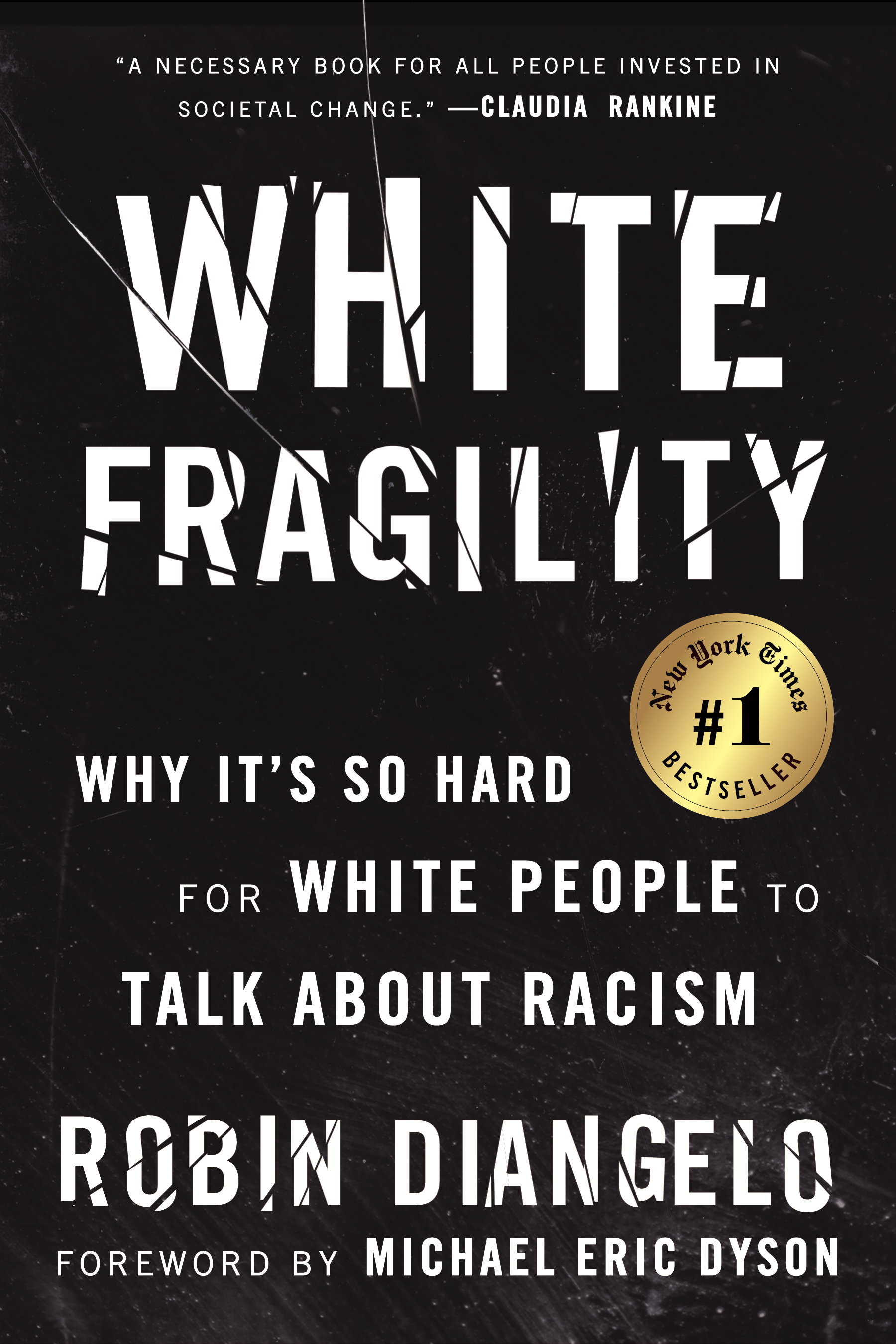
This morning I came across this luminous insightful paragraph on page 132 of Robin DiAngelo’s White Fragility:
Many of us see emotions as naturally occurring. But emotions are political in two key ways. First, our emotions are shaped by our biases and beliefs, our cultural frameworks. For example, if I believe—consciously or unconsciously—that it is normal and appropriate for men to express anger but not women, I will have very different emotional responses to men’s and women’s expressions of anger. I might see a man who expresses anger as competent and in charge and may feel respect for him, while I see a woman who expresses anger as childish and out of control and may feel contempt for her. If I believe that only bad people are racist, I will feel hurt, offended, and shamed when an unaware racist assumption of mine is pointed out. If I instead believe that having racist assumptions is inevitable (but possible to change), I will feel gratitude when an unaware racist assumption is pointed out; now I am aware of and can change that assumption. In this way, emotions are not natural; they are the result of the frameworks we are using to make sense of social relations. And of course, social relations are political. Our emotions are also political because they are often externalized; our emotions drive behaviors that impact other people.
It’s such a romantic notion — that our feelings are pure, apolitical, unsullied by the dirt and grime of being human or being in relationship with others. But when we assume that our feelings are apolitical, isn’t that another way of saying they are disembodied? This, I think, is one of the brilliant truths of orthodox Christianity: that a human community is “embodied” just as much as a single organism with flesh and blood. We speak of the community of faith as the Body of Christ. What does it mean to be embodied? It means that we belong to one another, and that we impact and shape one another. This is why speaking of structural racism or structural systems of privilege and oppression is entirely consistent with the heart of Jesus’s teachings.
Another point, that Diangelo implies but doesn’t go into — which is a basic principle of cognitive or rational-emotive-behavioral therapy — is that our thoughts shape our feelings. We feel a certain way, quite often, because our thoughts make that particular way of feeling possible, plausible, or probable. “If I lose my job, the world will come to an end” is a common way of thinking, even though it is rarely true on a strictly empirical level. Yet the person who thinks this way is likely to find getting fired or being laid off to be a deeply frightening experience. But if your way of thinking is “Losing a job is difficult, but it also can pave the way to new opportunities” then the emotional experience of being terminated will be very different. Probably still difficult — it never feels safe to lose income or a sense of purpose — but not devastating.
We can see how this applies to Robin DiAngelo’s work challenging white people to dismantle their own privilege and subconscious racism. If we think “Only bad people are racists” then we get defensive if someone points out when we are acting in racist ways. But if we think “Racism is a structural problem in our society that everyone has to work together to dismantle” then having our own racism pointed out to us still stings, but it’s easier to frame it as a challenge and an opportunity, not an attack.
So why am I writing about this on a contemplation blog? For a couple of reasons. First, contemplatives need to be engaged in work to dismantle oppression and privilege in our communities, which means those of us who are white have full responsibility for undoing our own racism. But I also think this question of “the politics of emotion” or the relationship between our thoughts and feelings is directly applicable to contemplative practice as well.
We often talk, in the spiritual direction world, about “image of God.” For most of us, our image of God is not so much a visual image (the old man with a beard, the all-loving Spirit) as it is a constellations of beliefs about God. Is God all-loving? All-forgiving? All-merciful? Kind and compassionate? Passionately interested in our well-being? In love with us? Committed to peace and justice, in ways that are holistic and affirming for everyone? Most of will, on a conscious level, answer “Yes” to questions like these. But the more interesting question is, “what do we subconsciously believe about God? Just as our subconscious patterns of privilege and prejudice mean that whites often behave in racist ways even though they believe themselves to be non-racist, so too our deeply hidden beliefs about God, or about humanity, or about the possibilities of spiritual practice, all shape what we experience (feel) in prayer, meditation, and contemplation. This is one of the reasons why I tend to be a bit skeptical of experience as the only arbiter of mysticism. Yes, experience is very important. But our experience can often be shaped by our beliefs or values (especially when they’re subconscious).
The point behind this is not to delegitimate our feelings or experiences! But rather to hold feelings and experiences lightly, and to recognize that just because we feel something strongly doesn’t make it objectively “true.” Learning to fearlessly understand our thoughts, beliefs, values and views that undergird our feelings — whether our feelings about race, justice, privilege, or for that matter, about God, prayer, and mystical awakening — is a way to grow in both authenticity and freedom.
A few years back the Buddhist magazine Lion’s Roar published an interesting article surveying what insights we can glean from the scientific study of meditation. These insights concern questions such as the health and psychological benefits of meditation, the relationship between meditation and compassion, and how meditation might impact our relationships and even our biases. It’s an interesting article and I encourage you to check it out (see the link at the end of this post).
The practice of meditation has been with us for centuries — in the west we know it dates back at least to the time of the desert mothers and fathers of Egypt, and it’s likely it goes back further than that (Aryeh Kaplan’s wonderful book Meditation and the Bible offers some tantalizing clues to how meditation might have been practiced in ancient Israel before the time of Christ). And of course, the Buddha meditated his way to enlightenment some 2500 years ago. But the scientific study of meditation is quite a new field, although research is taking place at numerous settings around the world. I have participated in several studies for Emory University; you might want to check to see if institutions near you are conducting studies on meditation and see if you could qualify to participate as a “lab rat.”
I remember my first spiritual director telling me, almost forty years ago, that meditation is something that is good for the soul, the mind, and the body. Back then she was going on anecdotal evidence, but the understanding was that a regular, stable meditation practice not only could help us get closer to God (or enlightenment) but could support a sense of calm or inner peace, and help to alleviate stress which naturally carries physical benefits. Since I’ve been wearing a fitness tracker I’ve noticed that my heart rate typically drops about 10 beats a minute during a 22 minute period of Centering Prayer.
Fast forward to today, where it seems that research is vindicating the idea that meditation provides health benefits, even if only in minimal ways. I appreciate the fact that the researchers who are examining the science of meditation are cautious and careful in reporting their findings in a balanced and hopefully objective manner. To me, saying meditation provides a “modest” impact on physical health is not an criticism of meditation, but rather an honest assessment that it’s good for you, but not a panacea. If you want to reduce the risk of heart disease, or manage your blood pressure, etc., by all means I would encourage you to make meditation part of your overall plan of care, but only part — we still need to consult with our healthcare providers to establish an our overall strategy for maintaining or improving our optimal health.
One of the findings that the article covers might surprise people who appreciate the spiritual and health benefits of meditation — but it’s important, so I want to highlight it: Meditation isn’t good for everyone all the time. In unpacking this statement, the authors of the article make this critical point:
For individuals who have experienced some sort of trauma, sitting and meditating can at times bring up recent or sometimes decades-old painful memories and experiences that they may not be prepared to confront.
This tracks with an important lesson I have learned, especially through the interviews I’ve participated in as part of the Encountering Silence podcast. For years, I have been convinced that meditation is a tremendous gift especially for people who (like me) struggle with depression or anxiety. And I still broadly believe that meditation is/can be a healing and helpful practice. But trauma survivors often may find that meditation can be a challenging experience, for it can bring us face to face with memories or feelings tied to our trauma — and if we are not prepared for this, or even simply not ready for it, such experiences, even in the context of meditation, can be upsetting or frightening. Thomas Keating described such a process as “the unloading of the unconscious” — apparently it is quite common for people who engage in deep or sustained meditation practice to, sooner or later, face forgotten or perhaps even repressed memories, images, feelings, thoughts, that can represent old wounds. For some people this might just be like a “bumpy ride” — but with caring spiritual direction, and perhaps the support of a qualified therapist, moving through such difficult or painful inner experiences can be a way of healing our relationship to the past. But the more traumatic such past experiences were, the greater the potential that encountering them in meditation can be distressing.
Does this mean we shouldn’t meditate? Not hardly. But it does mean that people who are the survivors of trauma may want to anchor their experience with meditation in a safe and trusting relationship with a therapist, in addition to a caring spiritual guide (assuming your meditation practice is, like Centering Prayer, spiritual in nature). And for those of us who have mostly positive experiences of meditation, it’s helpful to remember that others may have a different experience that is consistent with their own journey with trauma and suffering.
As I write these words, I am reminded of a friend of mine who read a book about Centering Prayer some years ago. She read a book about it, but did not attend a Centering Prayer workshop or group. She was not working with a spiritual director. When she tried the practice, she had an imaginal encounter with what she described as a demonic spirit. This frightened her terribly, and when she confided in a friend, the friend told her that Centering Prayer was dangerous because it exposed the mind to demonic attack. Needless to say, this person remains vocally hostile to Centering Prayer or any other form of meditation.
It’s a sad story, especially because my friend is now so closed and opposed to a practice that, with appropriate guidance, she could have learned to find deeply valuable. Let me be clear: the historic Christian tradition does not teach that meditation leaves us vulnerable to demonic attack! That is a modern misconception, no doubt inspired by people who have had unfortunate experiences like my friend. Historically, Christianity has taught that unfriendly spirits attack us not through silence, but through our thoughts. Because of this, meditation (which teaches us to let thoughts go gently) is actually spiritually very safe! But just because it is spiritually safe does not mean there is no (psychological) risk or danger. Although I don’t know my friend well enough to say (and I am not qualified to diagnose her), my hunch is that it was her own trauma that bubbled up even during that initial exploration of prayerful silence. Without a wise guide or supportive community to help her make sense of the experience and process it in a safe and therapeutic way, she was vulnerable to someone’s spiritual scare-tactics, with unfortunate results.
What’s the takeaway here? Meditation remains something that is generally very good for us, physically as well as mentally and spiritually. But it is a meaningful and powerful process for accessing the depths of our ordinary human awareness, and therefore can lead to uncomfortable or even painful experiences of traumatic memories, feelings, and thoughts. Therefore, anyone who wants to explore meditation in a serious and/or sustained way, ought to be careful to find supportive friends, allies and caregivers, including a group or community of fellow practitioners, a knowledgeable and compassionate spiritual director, and/or a therapist who is familiar with the psychology of meditation. With such supportive colleagues and caregivers, meditation can be truly a meaningful and even joyful practice — and even the unloading of the unconscious can be simply part of an overall process of fostering greater psycho-spiritual health and wellness.
I am happy (and honored/humbled) to announce that I’ve recently appeared as a guest on the new podcast from Contemplative Outreach! Opening Minds, Opening Hearts is a new initiative from Contemplative Outreach International, hosted by Colleen Thomas and Mark Dannenfelser. Other episodes of the podcast feature wonderful folks like Lerita Coleman Brown and Adam Bucko. Definitely check it out and subscribe to it. You can access the podcast’s home page by clicking here: www.contemplativeoutreach.org/podcast — or scroll down to read more about my episode and to listen…
Episode 1: Centering Prayer as a Gesture of Consent
“The gesture of centering prayer is a gesture of consent, willingness, openness, receptivity and basically saying to the spirit ‘Here I am and you are love’. I am thrilled to be responding to your love and I’m choosing to spend the next minutes available to you ” — Carl McColman
On this very first episode of Opening Minds, Opening Hearts, we welcome special guest and friend of Contemplative Outreach, Carl McColman. Carl is a spiritual leader, author, and teacher on mystical spirituality and contemplative living. Although Carl is a practicing Christian, his approach to contemplation and mysticism is inclusive and expansive. Carl sees the elegance and simplicity of the method of centering prayer as a larger conversation that the Christian community is having about reclaiming this contemplative practice.
What’s in this episode:
The relationship and distinctions between mystical traditions, Christian meditation, contemplation, and Centering Prayer.
Silence, sacred words, and the daily practice of Centering Prayer.
Father Thomas Keetings’s metaphor: Centering Prayer compared to boats on a river
Exploring the four guidelines of the method of Centering Prayer.
Mysticism as theology and the accessibility of Christianity through the gift of contemplation.
The four questions used in spiritual direction and slowing down to savor the graces.
The importance of interfaith dialogue, diversity, and inclusion in relation to the struggle for justice.
You can also to this episode (and subscribe to the podcast) on Spotify • Apple Music • Google Play • Pandora. Be sure to listen — and subscribe — today!
One of my favorite topics to explore when leading a retreat is “The Mystical Imagination.” I often pair it with Centering Prayer, exploring how the silence of Centering Prayer naturally complements the inner imagery of prayer anchored in the imagination.
When I lead such retreats, I often will share a variety of quotations with the retreatants to make the case for why the imagination is so important, spiritually speaking. I thought it would be fun to list some of these quotations here. I invite you to reflect on these words, not merely as an argument for the importance and value of the imagination, but as invitations to enter your own imaginal space as a way to go deeper in prayer.
Praying with the imagination is not the same as Centering Prayer (or other forms of silent prayer). It’s a kataphatic form of prayer in contrast to the apophatic nature of silent methods of prayer. I invite you to see these ways of praying as complementary. Not everyone feels drawn to silent prayer, and not everyone is drawn to imaginative prayer. Some people, like me, love it all (I’m weird that way), but I encourage you to simply trust your own mind and heart to determine what “prayer style” is right for you. As Abbot John Chapman was famous for saying, “Pray as you can, not as you can’t”!
Imagination is more important than knowledge. For knowledge is limited to all we now know and understand, while imagination embraces the entire world, and all there ever will be to know and understand.
— Albert Einstein, Cosmic Religion and Other Opinions and Aphorisms
The fundamental job of the imagination in ordinary life, then, is to produce, out of the society we have to live in, a vision of the society we want to live in.
— Northrop Frye, The Educated Imagination
The prophet seeks only to spark the imagination of this people, and that in itself turns despair to energy.
— Walter Brueggemann, The Prophetic Imagination
So what could bridge that gap between what we perceive with our senses and the reality far greater than our rational minds? For me the answer is imagination… When I use my imagination in prayer and reflection, I glimpse a deeper reality beneath my everyday experience.
— Margaret Silf, www.ignatianspirituality.com
The real work of imagination is to make contact with the strange world in which we live and to serve as both guide and inspiration for our development within it. It is the way we evolve. Imagination presents us with possible, potential realities that it is our job to actualise. It also presents us with a world that would not be complete without our help.
— Gary Lachman, Lost Knowledge of the Imagination
Images of the imagination are not always ‘imaginary’ or untrue, but ‘imaginal,’ presenting truths of a different, inner kind… The psyche or soul is the imagination.
— Stephen Larsen, The Mythic Imagination
The mystical imagination can show us something that science, wonderful though it is, cannot, namely, it can show us the many grace-drenched and spirit-laden layers of reality that are not perceived by our physical senses. The mystical imagination can show us how the Holy Spirit isn’t just inside our churches, but is also inside the law of gravity.
— Ronald Rolheiser, “The Mystical Imagination”
Imagination is your interior sense. When you say imagination, you get into something pretty deep. . . . What normally people think of as imagination is simply fantasy . . . but imagination is not fantasy, imagination is creative. . . . The artist makes you an artist, whether you like it or not, or else you don’t connect . . . what is the deepest part of yourself, your heart or your whole self. . . . It gets right into the depths of you.
— Thomas Merton, “God Speaks to Each of Us: The Poetry and Letters of Rainer Maria Rilke” (audio recording), quoted in Carl McColman’s Eternal Heart
I perceived that God’s continual working in every kind of thing is so beautifully done—so wise and so powerful—that it surpasses our greatest imagination. God’s goodness transcends all thought, all comprehension. At that point, all we can do is contemplate God and rejoice. We allow ourselves to be filled with the overwhelming desire for union with our Beloved, to listen deeply for the divine call. We delight in God’s goodness and revel in God’s love.
— Julian of Norwich, The Showings (translated by Mirabai Starr)
Here, in this spark or “part of the soul” where the spirit, as religion says, “rests in God who made it,” is the fountain alike of the creative imagination and the mystic life.
— Evelyn Underhill, Mysticism
A layered reality is part of the [Christian] imagination. To possess this imagination is to dwell in a universe inhabited by unseen presences — the presence of God, the presence of saints, the presence of one another. There are no isolated individuals but rather unique beings whose deepest life is discovered in and through one another. This life transcends the confines of space and time.
— Wendy M. Wright, Sacred Heart: Gateway to God
The fourteenth revelation is that the Lord God is the ground of our praying. Arising from this, we are shown true prayer and steady trust and God wants us to be generous in both alike. In this way our prayer is pleasing to him and in his goodness he fulfills it.
— Julian of Norwich, Revelations of Divine Love (translated by Halcyon Backhouse and Rhona Pipe)
Yesterday I was leading a class for Zeitgeist Atlanta and one of the participants shared an amazing song by a musician named Spencer Lajoye, called the “Plowshare Prayer.” It is profoundly beautiful, and I’ve had it on repeat for pretty much the rest of the weekend. Check it out — here’s a video of a live performance of the song (you can also find it on Spotify or download it from Amazon or Apple).
It reminds me of a prayer I wrote last year called “General Intercessions.” When I wrote it, I posted it on Patreon, and this morning I thought it’s time to share it with everyone through the blog. Maybe these two prayers can flow together. I’ll let you decide. In any event, I hope you enjoy them and may each of them be an invitation for your own prayer.
General Intercessions
O Divine Lover, Creator, Healer, and Life-Giver, I offer these prayers to You — on my behalf, the behalf of those I love, and indeed for the sake of the entire world.
I pray for all the quiet people, those who may be shy, or introverted, or simply have little to say; those who prefer to stay in the background, doing simple work on behalf of their family or others they love, who shun the spotlight and avoid the grand gestures.
I pray for all the so-called ‘good Christian people,’ the churchgoers, the committee members, the ministry volunteers, the pillars of the local community who give so much of themselves and often ask or receive very little in return, who do it only for the joy of giving.
I pray for the artists, innovators of every type imaginable, from the obvious ones like painters, poets, fashion designers, musicians, and dancers, to the less visible creators, the event planners, the mechanics, the athletes and graphic designers, indeed everyone who creates something new.
I pray for the farmers and gardeners, the salt-of-the-earth types who know the soil and the rhythms of the seasons, who seek not so much to dominate nature as to partner with it, who take joy in the ordinary labor of tending the land and cultivating the bounty by which so many are fed.
I pray for nerds and the freaks and the geeks, the cosplayers and convention-goers, the ones who know all the stories and often weave new stories of their own, who seek meaning and purpose in the myths and legends of our time, who find community and insight in the tales we all enjoy.
I pray for those who suffer with addiction, whether it be the brutalizing terror of alcohol or drug dependency, or the slow anxiety of over-spending or compulsive gambling, or the hidden shame of pornography obsession — indeed for anyone whose lives are constrained by compulsion.
I pray for the inhabitants of the underworld places, the prostitutes, the drug dealers, the escort service providers, the peepshow performers and the strip club dancers, the victims of trafficking, and also for those who spend money to purchase their “services” or who profit from these.
I pray for the angry people on social media, the arguers, debaters, trolls, inflamers, who get caught up in emotional whiplash and shouting-match debates, who forget our common humanity and common quest for knowledge and simply insist on attacking all whose views differ from their own.
I pray for political and religious extremists, for those who become locked in their views and values and ways of seeing things, who can only regard those who differ as enemies or victims or dupes, who lose sight of the horror of violence and begin to entertain the idea that force is good.
I pray for the queer folks, the gay and lesbian and bisexual and pansexual persons, for transgender and nonbinary persons and all whose sexuality or gender takes them outside the neat lines of mainstream social convention, and for those who simply are asexual by choice or chance.
I pray for those who benefit from social privilege, whether by virtue of their skin color or gender identity or physical sex or socio-economic status; and I pray for those who suffer because they lack such privilege, as well as those who work hard to dismantle all divisive privileges.
And I pray for the forgotten people, for those whom I have forgotten to pray for, today or any day, as well as those who have no one to pray for then at any time; the homeless, the elderly, the abandoned, the runaways, the sick, the dying, the feeble and the forlorn.
I pray for all these, and in all cases my prayer is the same: bless us as we need to be blessed, heal us as we need to be healed, convict us as we need to be convicted, transform us as we need to be transformed, and strengthen us to love — to love You, to love ourselves and to love our neighbors and our enemies, so that we may allow You to work through us to repair our beautiful broken world.
N.B. This homily was written for the Community of Hope International at their annual retreat, during the Saturday evening Taizé service, October 8, 2022 at Camp Allen, Navasota, Texas. The readings included Psalm 66:1-12, Psalm 111 and Luke 5:12-16.
“The fear of the Lord is the beginning of wisdom.” This is a powerful statement, capstoning the beautiful song of praise that we find in Psalm 111. But what exactly does it mean?
If you are like me, you may remember knowing people — or at least, knowing of people — who were described as “God-fearing.” A God-fearing Christian was someone who took their faith seriously. They did not mess around. There was no hint of presumptuousness in their faith, they did not take their salvation for granted, and one might assume that their fear of God was intimately part of an overall spirituality shaped by reverence, moral rectitude, and an utmost respect for the power and judgment of God.
But you know, we live in the age of sociology and psychology, and the fear of God, as a religious concept, has fallen on hard times. We have begun to question if fearing God can really lend itself to loving God. As a friend of mine who is a Mennonite theologian once said, “Many people keep an eye on God the way the mouse keeps an eye on the cat.” We may do a perfectly good job of fearing God but remain entirely unmoved by any possibility of loving God.
The plot thickens! Recent scholars of Biblical Hebrew have made the case that the Hebrew word that gets translated as fear — yir·’aṯ — really should be understood as implying awe. We may fear an abusive parent, but we experience awe when we contemplative the Milky Way galaxy. I live in Atlanta where there is so much light that we rarely can see many stars, even on the clearest of nights. But a couple of years ago my wife and I were on the coast of the Gulf of Mexico during the Leonids Meteor Shower; we read online that the best time to see it was about 4 AM. So like Trappist monks we got up before dawn, bundled up — that November morning was quite chilly, even in Florida — and we made our way to the beach, where we sat, gazing south over the gulf, hypnotized by the steady drone of the surf, and entranced not only be the dramatic meteors that kept streaking across the sky, but by the unexpected delight of clearly discerning the Milky Way, dancing across the firmament like a ribbon of ancient light. Immediately, we felt awe: awe at the sheer beauty of it all, awe at the vastness of the universe and our corresponding tiny-ness, awe at the immeasurable unlimited dimensions of space and time to which we were privileged to be given this tiny glimpse at a specific moment in time. I don’t know if it was made us wise, but I do know that we tasted awe that autumn morning — and it felt nothing like fear.
Still, I can understand why “the Fear of the Lord” is a thing. Believe it or not, I was a timid child, and I grew up in a very traditional gendered household where mom was the nurturer and dad was the disciplinarian. My relationship with my mom was very intimate, warm, and cuddly, whereas my father and I had a very formal and rather distant relationship. Mom and I hugged, but Dad and I shook hands.
So why would someone fear God? Let me hasten to say that I don’t think God is particularly turned on by the idea of us fearing him. But I do think that a person who is amending their life, perhaps coming to face some hard truths about themself and their tendency toward selfishness, narcissism, and perhaps even lack of caring for others, might find that being afraid of God’s terrible judgment may be part of theprocess of compunction, contrition, and repentance. Those are tough words, so let’s take a closer look. Compunction is like getting poked by a sharp object — it’s a jabbing sensation of pain that comes from recognizing that one’s behavior has been, well, sinful — or to put it in more contemporary language, unkind, unloving. Our Buddhist friends would say it isinevitable that human beings cause suffering. Compunction is feeling the pain that our behavior creates, both for ourselves but especially for others.
The next step, contrition, is feeling sorry for what we’ve done. In the Roman Catholic world, you need contrition in order to participate in the sacrament of reconciliation, or confession In other words, it’s not enough to admit you’ve done something wrong — you need to be sorry for it. This does not and should not be a matter of intense or long-lasting shame. When we are contrite, we are called to do something to alleviate the unpleasantness. Just as having a headache means it’s time to take your Acetaminophen, feeling contrition means it’s time for that most misunderstood of spiritual processes: it’s time to repent.
Many people equate repentance with compunction or contrition. But if they were the same thing, we wouldn’t need all these big words, would we? No, repentance is the solution to the problem of compunction and contrition, which in turn are problems that arise out of our sinfulness. To repent, you see, is to take your spiritual aspirin to counteract the pain of your aching contrition.
What is repentance? The Greek word for it is metanoia — which literally means “beyond the mind.” To repent literally means to adopt a new or higher level of consciousness — to go beyond the limitations of the old mind, conditioned as it is toward selfishness and fear. It means to adopt the Mind of Christ: a mind shaped by God’s presence, compassion and love. To repent is to exchange the old ways of seeing things that are based in fear and dualism, for a new way of approaching life grounded in trust, kindness, mercy, forgiveness — and the love of God.
Well, when you see it that way, repentance sounds awesome! When can we sign up for it!
And you notice, I said AWE-some! Yes, repentance may mean the shift from fear into love, but it is still grounded in that awe before God which the Psalm assures us is the beginning of wisdom.
You see, here’s how I think it works. The fear of the Lord — whether we are talking about awe — or dread — truly is the beginning of wisdom. But it’s not the “end” of wisdom. To find that, we need to turn to a powerful verse from the first letter of Saint John, tucked away toward the end of the New Testament. The fourth chapter of I John is a hymn celebrating the love of God, as beautiful in its own way as St. Paul’s legendary hymn of love found in I Corinthians 13. John assures us that “everyone who loves is born of God and knows God.” He goes on to say, more than once, that “God IS love,” which to my mind remains the single best one-word definition for the nature of God. But then he throws in this delicious word of wisdom:
There is no fear in love, but perfect love casts out fear; for fear has to do with punishment, and whoever fears has not reached perfection in love. (I John 4:18)
What a powerful declaration! I think it makes sense that we fear being punished, whether it is a child who doesn’t want to get spanked after stealing some cookies from the cookie jar, to the wealthy business person accused of tax fraud who fights the charges as hard as he can. Even if we acknowledge that we are guilty as charged, we seek clemency and mercy.
Paolo Veronese, “Christ in the Garden of Gethsemane” (1570)
But what if we can let go of all fear of punishment when we encounter the presence of the Living God? What if, even in our sinfulness and brokenness and imperfection, we can approach God with love rather than fear, with trust rather than anxiety, with the confidence of a child rather than the bargaining of an adult?
If fear is the beginning of wisdom, sooner or later love will come along and cast fear out, replacing the terror of the small mind with the limitless trust of the Mind of Christ. And remember, when we say “love casts out fear” — remember, God is love. If we allow God entry into our hearts, God will seek to turn us away from fear and toward the deepest wisdom of all, the wisdom of profound, trusting, love.
We see in tonight’s Gospel reading a powerful insight into Jesus. Everyone knows Jesus was a healer, and so this reading from the fifth chapter of Luke represents Jesus doing what Jesus does best: healing the sick. But as Jesus’s gift as a healer turns into a rapidly spreading reputation — even without Twitter and Facebook, word spread fast — Luke points out something really important: “he would slip away to deserted places and pray.”
Next time you sit down to read the Gospels — not just to listen to the short lessons that show up on Sunday mornings or during your daily prayer, but to really read the entire narrative — notice how much Jesus prays. It seems like he is always sneaking off to be alone with God. From the forty days in the wilderness right after his baptism to the night in the Garden of Gethsemani before his arrest, trial and crucifixion, Jesus is consistently a person of prayer. And friends, I would like to make two observations about this: first, that it is not mistake that Luke comments on Jesus’s prayer right after telling yet another story about his gifts as a healer. For Jesus, prayer and healing go hand in hand. But just as important, ask yourself: is Jesus’s behavior the actions of somebody who is scared of God? I don’t think so. Jesus prayed all the time because Jesus LOVED God, and Jesus trusted in God’s love for him. And we are asked to enter into the same dynamic when we related to God. God is love. Love casts out fear. We are able to love, because God first loved us. Think about what that implies: the more you immerse yourself in the presence of God, the more loving a person you become. Let me repeat that: the more you immerse yourself in the presence of God, the more loving a person you become. I don’t know about you, but that thought makes me want to pray as much as I possibly can.
Carl McColman answers a question after speaking at the Community of Hope annual retreat, Camp Allen, Texas, October 8, 2022.
Psalm 66 invites us to make a joyful noise to God! Even though I myself am an introvert with monkish tendencies who likes nothing more than a quiet evening at home, I can relate to Psalm 66. I think making a joyful noise to express our love for God is a beautiful thing to do — and I commend it to us all. Sing, scream, shout for joy: praise the God who loves us so much!
But you know, the psalm right before Psalm 66 — Psalm 65 — makes another powerful statement about praise. It often gets lost in English translations, but he original Hebrew of Psalm 65:1 very explicitly says, “Silence is praise.” What an extraordinary statement! Silence is praise. This is not either/or: we still praise God with our joyful noise. It’s a both/and situation: we praise God with our songs and our words, but we also praise God with our reverent, awe-struck silence. Silence can be a wonderful way to notice the love in our hearts: love that is put there by God through the Holy Spirit! Don’t believe me: check out Romans 5:5. So let’s celebrate the wisdom that might begin with fear, or better yet, awe — yet ultimately yields to the beauty of love. Just as our praise may begin with a joyful noise, but ultimately even our silence can be a way of returning love to the one who gives us the ability to love.
So let’s take a few minutes now, and be silent before the beautiful, compassionate, merciful, presence of the God who IS Love — and who loves us all, so very, very much!
I recently received the following heartbreaking message through my website. Normally this is the kind of message that I would answer with a private email, but the person who sent it did not give me her email address. So, I’ve remove some details to protect her privacy, but here’s the message:
Thank you for the recent article “Memento Mori: The Contemplation of Death and the Wonder of Life”
My daughter died from an overdose 2 weeks ago. I have horrible thoughts and visions of her dying alone, so suddenly with no one by her side. My faith and hope is always in God, but where was God when she was dying like that? Can you recommend any articles or books that speak to this. It seems all books on death and dying are for those who’ve passed knowing they’re on the way. I need to know God was with her while she lay in moratorium for hours before being found. Many thanks in advance.
First of all, I am heartbroken for you and your family. Please know I am praying for you and I send you my deepest condolences. My daughter died eight years ago from natural causes, so on one level I know what you’re going through and an another level I have no idea. I know that there are no words for a time like this, so just know that I am so, so sorry.
Where was God in your daughter’s hour of greatest need? I know it is a terrible mystery as to why God allows such things to happen. I cannot begin to speculate, other than to quote Julian of Norwich, who maintained that when God keeps something secret from us, our best course of action is to trust in God, hard as that may be. But as for where God was: that is easier to answer. I am sure God was holding her close, enveloping her with infinite, vast, unconditional love. For God is Love, and so Love must love.
To respond to your request for something to read: one book that I think might offer a bit of comfort and solace for you is A Message of Hope from the Angelsby the living Irish mystic, Lorna Byrne. Lorna Byrne’s particular gift is a lifelong capacity to see and communicate with angels. She has written several books, you can also find videos of her on Youtube and other video platforms. She’s very down-to-earth, just a normal Irish woman, but with a deep heart for the love of God as expressed through angelic spirits who care for us and guide us. Only one chapter in the book directly deals with death, but even its title would, I hope, bring comfort to you and your family. The chapter is called “No One Dies Alone.” Back to your question, where was God? God — and the angels, and I believe your ancestors as well — were with your daughter every step of the way.
I remember years ago hearing an Episcopal priest talk about a funeral he presided at. Only he and one acolyte were present. It was a dreary day as they blessed the coffin at the gravesite, before the undertakers took over with the task of lowering the remains into the ground. As the priest and his assistant walked away, the acolyte blurted out, “How said to be buried all alone.” The priest replied, “Alone? But we are surrounded by the angels proclaiming, ‘Make way, make way, for the image of God!”
Death is such a mystery, and when we love someone, we can be gutted by our grief. Losses that are sudden, accidental, or the result of violence or substance abuse can be even more painful. But I for one am convinced that every loss is cradled in the infinite love and mercy of God.
My great-grandfather, Carl Mattson, for whom I am named, died by suicide. He hung himself in the basement after fighting with my great-grandmother Serafina. This happened before I was born, so I never knew Carl Mattson, but I know his story, and it saddens me. But despite some stern messages I have received about the judgment of God, I trust that he died into the arms of mercy. I love Lorna Byrne’s simple message when she addresses the fear that so many of us have, that God will judge us (or our loved ones): “I have never been shown anything other than a soul going directly to Heaven.” It has been said of suicide: “Between the bridge and the river is the mercy of God.” I believe this with all my heart, and I believe it applies to all people, including those who die suddenly, accidentally, as the result of violence — or of overdose. We die into the mercy of God.
Lorna Byrne suggests that Heaven is a place of profound joy, and that those who go before us continually pray for us and watch over us with love and care (which is why I believe they will be waiting for us when we die). While it is heartbreaking for us to lose those we love, perhaps we can take comfort in knowing that their suffering has come to an end and that they have found a new and larger life in the heart of God.
A Message of Hope from the Angels is a very simple book, written entirely from the heart, with a message that is beautiful and filled with love. If you are also looking for a something that is a bit more philosophical in its approach, my favorite book on death and dying remains The Grace in Dying: How We Are Transformed Spiritually As We Dieby Kathleen Dowland Singh. Singh draws from contemplative wisdom traditions around the world, combined with the best psychology of death and dying, to present a truly beautiful description of how death is truly a letting-go into the silence of Divine Love.
Again, I am heartbroken for your loss. Be gentle with yourself, you are on a long journey of grief and healing. But I trust and believe with all my heart your daughter is safe in the arms of Love. I hope you will find comfort from that same Love.
On June 16, 2022 my friend and colleague Carmen Acevedo Butcher PhD is offering a free online program to explore the wisdom of Brother Lawrence of the Resurrection, author of The Practice of the Presence of God. Click here to register for this free event.
You probably know Carmen Butcher from her luminous translation of The Cloud of Unknowing. Later this year she is releasing her latest book, in which she is bringing her wisdom and translation skills to Brother Lawrence, in a vital and fresh new translation of his book called Practice of the Presence: A Revolutionary Translation. Here’s an opportunity to dive into Brother Lawrence’s mystical spirituality with Carmen Acevedo Butcher as your guide!
The webinar will take place on Thursday, June 16 at 8:30 PM Eastern Time. It will be recorded, so register even if you cannot attend on the 16th. Click here to register for this free event.
More information about this event
Each day, we’re bombarded with stressful news and other distractions — on our televisions and phones, in the conversations around us, and within our own quiet moments of reflection.
The wisdom our world needs right now, affirms Carmen Acevedo Butcher, PhD, an award-winning translator of spiritual texts, can be found in the teachings of Brother Lawrence, the Friar d’Amour.
Brother Lawrence was a down-to-earth mystic, monastery cook, sandal repairer, and disabled veteran who limped painfully all his adult life.
He lived through a time that was strikingly similar to our own — marked by authoritarianism, political division, social and economic disparities, climate crises, hunger, plague, global death, and war.
As a result, his writings, found after his death in 1691, are filled with profound yet practical tools and wisdom that apply to our moment in history — equipping us to live more calmly and deeply as we connect with ourselves, others, and God.
On Thursday, June 16, join us for a powerful event with Carmen to discover more about Brother Lawrence’s gentle, simple practices for returning to love — and feeling more grounded in the midst of life’s biggest distractions and greatest challenges.
Register for Practicing Unshakable Joy With Brother Lawrence, the Friar d’Amourby clicking here.
Carmen Acevedo Butcher, PhD
In this free online event, you’ll discover:
A guided imagery exercise to befriend your feelings and welcome them into your life — so you can experience healing, let go of any desire for power and control, and create a space for what Brother Lawrence called “unspeakable joy”
How the teachings of 17th-century friar Brother Lawrence — including the practice of the presence of God — are a beacon of hope that can help you navigate today’s challenges and crises
How to uncover the often repressed and overlooked feminine energy in Brother Lawrence’s teachings that can help you embody greater “mother compassion” — accepting the holy in yourself while listening to the holy in others
Brother Lawrence’s gentle, simple practices for returning to love and our inherent groundedness in the midst of everyday distractions and life’s greatest challenges
The newest translations of Brother Lawrence’s teachings that unveil his path to self-compassion – and the importance of cultivating this quality to bring loving kindness into every encounter
As you’ll discover, Brother Lawrence’s wisdom and practices can bring you home again — into yourself and back to love — as you cultivate an inner sense of calm and the ability to act lovingly.
Note: I don’t often promote events like this and it’s my policy to do so only when I am convinced the event will be a true blessing and good value to those who participate. With that in mind, I am happy to endorse this event with Carmen Butcher. In fact, I’ve signed up for it! So I hope you will too.
Recently a reader of this blog wrote the following to me:
I am just starting out on this journey and feel drawn to the mystical/contemplative side of Christianity. To this end, I am using your book “Answering the Contemplative Call” and also “Growing into God” by John Mabry as my guides. I do not have a spiritual director as yet but am trying to find one near where I live in the UK. In the meantime, I am using the 2 books mentioned above and finding them very useful. By the way, I love Julian of Norwich but find St. John of the Cross beyond me!
My difficulty is that I am confused between the God of the mystical tradition and some aspects of the God of the Bible (particularly the Old Testament). The God who “doesn’t hold anything against us and never has” seems at odds with the God who does show anger against evil and injustice in the bible. As maybe He should, given that so much suffering is caused by cruelty, greed, injustice etc. So where does this idea that there is no wrath in God and that He doesn’t hold anything against us come from? Is it just wishful thinking?
This is such a great question. Thanks for asking it! I am actually currently at work on a new book about reading the Bible in the light of the wisdom of the mystics (God willing, it will be published in 2024), so your question is very apropos!
For readers who may not be knowledgeable about Julian of Norwich, she was a medieval visionary who experienced sixteen revelations or “showings” during a serious illness she experienced as a young woman, in May 1373. These visions were theologically rich and filled with insight, particularly in terms of God’s love. Indeed, Julian’s book of theological, contemplative reflections on her showings is often published under the title Revelations of Divine Love.
Among other things, Julian remarks that her visions gave her a new perspective on an idea about God — an idea that probably was quite common in her 14th century experience of Christianity: the notion of “the wrath of God.” Julian writes,
I saw no kind of wrath in God, neither for a short time nor for long. (For truly, as I see it, if God were to be angry even a hint, we would never have life nor place nor being.) As truly as we have our being from the endless Power of God and from the endless Wisdom, and from the endless Goodness, just as truly we have our protection in the endless Power of God, in the endless Wisdom, and in the endless Goodness.
Elsewhere in her writing Julian notes, “I saw no wrath except on man’s part, and that He forgives in us. For wrath is nothing else but a rebellion from and an opposition to peace and to love, and either it comes from the failure of power or from the failure of wisdom, or from the failure of goodness (which failure is not in God but it is on our part).” These quotations are from The Complete Julian of Norwich.
Wow. It’s a compelling argument. There’s no such thing as wrath in God! And furthermore, when human beings have thought we saw wrath in God, Julian is basically saying that we are projecting our own human anger on to God, for God is perfect power, wisdom, and goodness, and anger stems from a “failure” of power, wisdom or goodness in human hearts.
The problem, as my reader points out, is that the Bible offers images of God that seem quite wrathful indeed:
For the wrath of God is revealed from heaven against all ungodliness and wickedness of those who by their wickedness suppress the truth. (Romans 1:18)
Beloved, never avenge yourselves, but leave room for the wrath of God; for it is written, “Vengeance is mine, I will repay, says the Lord.” (Romans 12:19)
Put to death, therefore, whatever in you is earthly… on account of these the wrath of God is coming on those who are disobedient. (Colossians 3:5-6)
They will also drink the wine of God’s wrath, poured unmixed into the cup of his anger, and they will be tormented with fire and sulfur in the presence of the holy angels and in the presence of the Lamb. (Revelation 14:10)
There are many others, I just chose a few. And I made a point of choosing examples from the New Testament, to avoid the subtly anti-semitic notion that God is only depicted as wrathful in the Old Testament, before Jesus came along to clear things up. Alas, images of God-as-wrathful are found throughout the Bible — just as images of God as merciful and forgiving can be found in the Jewish scriptures as well as in the New Testament.
So what are we to make of Julian’s assertion? Was she simply wrong? Or, if we agree with her, does that mean we are rejecting the authority of the Bible? This is a tough nut to crack!
Julian of Norwich: Mystic, Visionary… and Interpreter of Scripture
The Bottomless Well of Meaning
This question is ultimately a question about how we read the Bible — and interpret it for our time. For many Christians, the Bible is seen almost like a technical manual, or a legal code: it contains very precise language, with clear-cut meaning that must be understood and applied in the one acceptable way.
But not everyone sees the Bible that way. To begin to illustrate this idea, let me recount a story I just heard the other day. Last week I participated in an interview with Brian D. McLaren, and at one point he told us about a conversation he had with a rabbi a few years back. The rabbi asked Brian why Christians are so focused on finding the one correct meaning of each and every verse in the Bible. She saw that as foreign to the way many Jews read the Bible.
“The Bible is a bottomless well of meaning,” remarked the rabbi. “Why would you want to stop its meaning with one interpretation?”
This reminded me of a conversation I had with my wife, just a few days earlier. “I think many people see the Bible as speaking with one voice,” I pointed out. “But actually, there are many voices in the Bible, offering different — and at times conflicting — ideas about God, about humanity, about theology and spirituality and ethics. The Bible is more like a lively conversation than a monologue.”
If we take the rabbi who spoke to Brian McLaren seriously, it invites us into what, for Christians, represents a radically new way to think about the Bible. It is a record of centuries of religious imagination, reflection and discernment rather than a single, definitive statement about God that cannot be questioned in any way.
Many Christians have been taught to view the Bible as the inerrant word of God. It’s a hermeneutical principle which insists that there is no error in scripture. (Hermeneutics refers to the principles by which a text is interpreted). But not all expressions of Christianity include a requirement to believe the Bible is inerrant. While pretty much all mainstream forms of Christianity see the Bible as authoritative and as an expression of the word of God, it is possible to hold those beliefs while also accepting the Bible as written by human beings (even if inspired by God) and therefore subject to human limitations and blind spots.
The problem I see with the belief that every single verse in the Bible must be inerrant is that it does not address the many problems and disparities that even a casual reading of the Bible can reveal. Even within scripture itself, there are clearly statements that most people would acknowledge are contradictory to other statements within the Biblical text. Let’s look at a few of the more obvious inconsistencies:
In Genesis 32, Jacob proclaims “I saw God face to face, and yet my life was spared.” But by the time of Moses, God is saying “You cannot see my face, for no one may see me and live” (Exodus 33:20). Jesus, however, seems to opt for Jacob’s perspective, since he taught “Blessed are the pure of heart, for they shall see God” (Matthew 5:8)
Jesus promises us that “With God all things are possible” (Matthew 19:26), but the author Judges apparently never got the memo, for he comments that God could not even defeat chariots made of iron: “The Lord was with Judah, and he took possession of the hill country, but could not drive out the inhabitants of the plain, because they had chariots of iron.” (Judges 1:19)
Regarding God’s wrath, consider this harsh statement found in Exodus 20:5, “I the Lord your God am a jealous God, punishing children for the iniquity of parents, to the third and the fourth generation of those who reject me.” By the time of the prophet Ezekiel, a more balanced perspective emerges: “A child shall not suffer for the iniquity of a parent, nor a parent suffer for the iniquity of a child; the righteousness of the righteous shall be his own, and the wickedness of the wicked shall be his own.” (Ezekiel 18:20)
Likewise, there are other examples of how later Biblical texts will, in essence, override an earlier principle, such as Jesus’s famous reversal of the Old Testament “eye for an eye”:
“If any harm follows, then you shall give life for life,eye for eye, tooth for tooth, hand for hand, foot for foot, burn for burn, wound for wound, stripe for stripe.” (Exodus 21:23-25)
“You have heard that it was said, ‘An eye for an eye and a tooth for a tooth.’ But I say to you, Do not resist an evildoer. But if anyone strikes you on the right cheek, turn the other also.” (Matthew 5:38-39)
There are many other examples of this kind of Biblical discontinuity (a tip of the hat to the American Atheists website for their List of Biblical Contradictions page!)
So can you see the face of God and live? Or not? Will God punish children for the sins of their parents — or not? I don’t see how anyone can honestly consider tensions like these without accepting that at least some of them represent errors, or at least obsolete ideas.
Christians sometimes try to resolve some of the Bible’s apparent inconsistencies by arguing that the New Testament represents a “new and improved” revision of Old Testament theology. Jesus, especially, trumps anything in the Old Testament, so his comments about turning the other cheek are seen basically as an acceptable revision of an old, but no longer valid, way of thinking about God. But even this has its problems: what do you do when you run into tensions in the New Testament; for example, Jesus and Paul have clearly different understandings of the function of the Jewish law — see Matthew 5:17-18 and Romans 6:14?
All of these apparent contradictions, disparities, tensions, differing or opposing viewpoints are only a problem if we insist in reading the Bible as a unified document declaring only one correct way of understanding God. But if we join the rabbi quoted above, and are willing to view the Bible as an “endless well of meaning,” we can begin to consider the idea that many verses can be interpreted in multiple ways, and even the most glaring contradictions might actually be invitations for us to reflect on how our understanding of God, and truth, and spirituality grew and evolved over the centuries in which the Bible was written — and continue to evolve to this day.
So rather than getting caught up on what is absolutely the “one correct way” of reading the Bible, we can approach the Bible as a “work in progress” — as the word of God that is still being spoken. Like any good story, we can expect character development — only in the Bible, it’s not so much that God is “developing” but rather that the human understanding of God is growing and evolving. So some images of God in the Bible are, obviously enough, going to be more helpful than others — some might be more obsolete, more culturally conditioned, more shaped by outdated ideas where God is seen as terrifying, angry, patriarchal, wrathful — compared to other images (found within the Bible) that stress God as loving, merciful, kind and radically forgiving.
Enter Julian of Norwich
“I call them like I see them.”
One of the most loved of American sports is baseball, a game which is moderated by an impartial umpire, who makes on-the-fly decisions whether a runner is safe or out, whether a missed pitch is a strike or a ball, and so forth (if you don’t know baseball jargon, it just means the umpire is the one who makes final decisions about how the game is progressing, decisions that can be controversial and that affect who wins the game). A legendary story holds that an umpire, challenged by the accuracy of his decision, simply states “I call them like I see them.”
I think about that when I think about Julian of Norwich and the wrath of God. When it comes to her vision of God, I believe she called it like she saw it.
She very simply states “I saw no wrath in God” and also “I saw no wrath except on man’s part.” I think we need to hold both of these statements together to understand what Julian is saying. And I believe this: Julian is interpreting the Bible, based on her own visionary experience of God. She is challenging us to re-think what the very concept of “the wrath of God” as found in the Bible means.
There’s plenty of language in the Bible about God’s wrath. But there’s also plenty of language in the Bible stressing God’s love, mercy, compassion and forgiveness. Are we to assume that God is moody — angry some of the time, but understanding and forgiving the rest of the time? That sure sounds like projecting a human quality (the changeable nature of our emotions) unto God!
Julian offers a different interpretation. She boldly suggests that “the wrath of God” is essentially a mirror of human wrath, projected onto God. We human beings — including Biblical writers — are prone to assuming that God is basically a mirror image of ourselves. Since human beings get angry and wrathful, therefore God must too. And Biblical writers inserted this into their way of speaking about God. But Julian, based on the authority of her own experience of God, isn’t having it. She calls us to a new way of seeing God.
Julian reasonably argues “if God were to be angry even a hint, we would never have life nor place nor being.” In other words, the wrath of God would simply annihilate all existence. We are held in existence by God’s creativity, God’s love and God’s sustenance (see Julian’s “hazelnut vision” for more on this). Her point: if God really got angry, we would be completely and utterly annihilated by the terrible force of that wrath.
Therefore, God may judge us, God may hold us accountable for our sins, and God may expect us to take responsibility for our actions. But all of this emerges out of God’s love and justice, not God’s wrath.
I understand that not everyone will be comfortable with this kind of radical re-visioning of how we as Christians can read the Bible. But I am convinced that the Jewish idea of the Bible as a well of endless meaning simply makes more sense than a more brittle idea that the Bible can only have one correct meaning. No wonder there is so much division in Christianity: we’re all arguing over the correct way to read the Bible, and it’s a zero sum game if we believe there’s only one correct reading. Only one interpretation can be correct, all the others must be wrong: erroneous if not heretical.
But if we are willing to entertain the idea that the Bible is meant to guide us in our relationship with God, but not to suppress us into submission to just “one correct” way of reading it, then we are free to let the Bible be in conversation with itself, and to allow other inspiring and learned commentators (like Julian of Norwich and many of the other mystics) offer us insight into how to read the Bible as well. Of course, Julian — like anyone else — may have made mistakes, gotten some things wrong. We are not required to slavishly obey everything she (or anyone else) says about the text.
Our job may seem daunting: we need to bring critical thinking and adult discernment to bear when we read the Bible (or for that matter, when we read Biblical scholars, commentators and interpreters). We can be assured that we will not always agree with the experts, or each other (and we have to be humble enough to admit that we ourselves don’t always get it right either).
Back to my image that the Bible is more like a conversation than a monologue: we who read the Bible here in the third millennium are invited to join in an ongoing conversation, that has already been continuing for centuries and will carry on long after we are gone. We need to do so humbly, acknowledging that we don’t have all the answers. But when a writer says something that rings true, it’s worth taking it on, at least as a hypothesis.
For me, Julian’s declaration that there’s no wrath in God absolutely rings true. When I hear Christians talk about the wrath of God, I assume that they are telling me more about themselves and their beliefs and image of God, then offering me anything new about the God who is vast, limitless love and compassion.
“Wishful Thinking” — or Mystical Insight?
So does Julian of Norwich represent just “wishful thinking” when it comes to her commentary on the wrath of God — or is she offering us a kind of mystical insight into a new way of approaching God (and the Bible)?
Everyone who reads this blog post will have to answer that question for yourself. What rings most true for you? The idea that God must be wrathful because some ancient Biblical passages speak of God’s anger, or the idea that Julian’s insight into scripture can offer us a deeper appreciation of God’s love, even though it may mean interpreting the Bible in a different way than we are used to?
For what it’s worth, here’s my perspective; I don’t think Julian’s words represent just “wishful thinking” at all, but rather an important and profound theological statement. Julian is calling us to a more consistent and hopeful understanding of God as infinitely loving, infinitely compassionate, infinitely merciful. To do this, we have to learn new ways of interpreting the Bible (maybe more like our Jewish friends, and less like fundamentalist Christians). But the good news is, we can continue to read the Bible as an inspiring text, while also taking into consideration the wisdom of all the ages in learning how to interpret it most consistently (and most lovingly).
One final point: my reader speculates that it may be necessary to believe that God is wrathful because God naturally is opposed to evil and injustice. That’s a good point, but then I am reminded of Jesus’s teaching to “love your enemies” (Matthew 5:44). Certainly Jesus would not command us to do something that is not already present in the heart of God! We are to love our “enemies” because God loves everyone, even those who are responsible for evil and injustice and suffering.
God’s love does not mitigate God’s justice. A God of infinite and unalloyed love will still demand that we mortals take responsibility for repairing all the ways that we have caused suffering (for others, or even for ourselves). God remains the God of justice, of siding with the vulnerable and the oppressed, with opting for the poor and the downtrodden. But God does all of this out of love. Even how God deals with those cause harm, who oppress or who are unjust — it will all emerge out of infinite love. I, for one, think it’s a far more humbling thought to have to hold up my sins and imperfections to love, than to anger!
But as humbling as that thought may be, I’m also comforted by knowing that there is no limit to God’s mercy, and that God is with me every step of the way: from my admission that by myself I am ultimately incapable of righting my wrongs, to my feeble efforts to make amends when and where I can, to my ultimate giving of myself entirely to God’s clemency and mercy.
See? No wrath necessary. God is love. Love will handle everything.
The same reader asked me both of the following questions, in two separate social media posts. but since they’re from the same person, I’m putting them together in this one post.
It’s interesting what you say about seminaries. I’m considering a possible call to enter the priesthood, but i just Dont know if I’ve got the time or desire to spend 6 or 7 years in a seminary, learning what other people have said about Jesus… Plus my approach to Christianity is very much ecumenical, I see part of our role in the church is to unite it, and heal the divisions… if I get ordained a Catholic priest, won’t that alienate my Protestant and Orthodox brothers in Christ? I guess maybe you just have to pick one denomination, and then work out from there? Any guidance on this issue is very welcome Carl! Thanks
I’m not able to guide you on whether or not you have a vocation — that’s something you need to pray about and discuss with trusted spiritual friends and mentors in your own community. Talk to a local priest to get some guidance. But I would like to address two points you mention in your question. First, the matter of “learning what other people have said about Jesus”… I would caution you against seeing that as a negative. After all, we all “met” Jesus through “other people” — beginning with Matthew, Mark, Luke, John and Paul! Christianity is a faith built on relationships, and we all are continually giving Jesus to one another, through our compassion, our friendship, our kindness, our mercy and forgiveness, our struggle for justice and truth and peace. Part of the “job description” of being a Christian is that we bring others to Christ, and we bring Christ to others. So don’t close your mind to the idea that you can learn from the great theologians, Bible scholars, saints, and mystics of ages past. They really do have a lot to teach us. For example, I would say the single most important person in my life — when it comes to my understanding of who Jesus is and what a relationship with Jesus means for me today — is Julian of Norwich, the medieval mystic! Reading Julian really made Jesus come alive for me. Another good book, more contemporary, is James Martin’s Jesus: A Pilgrimage. If you haven’t read it, I highly recommend it! Anyway — allow yourself to learn from others. You can disagree when your conscience dictates that you do so. But still learn. See how other people relate to Jesus, It will make your relationship with Christ that much larger and deeper.
Now, the second point involves ecumenism. You are raising a good point, but there is more than one way to look at it. Becoming a minister of any church does mean you become a team player in that particular organization. So it is important to pursue ministry only in a church that you feel can be your spiritual home for life. Otherwise, it could indeed feel very constraining. As it is, many people do switch churches after getting ordained, but that can be disruptive to their career/income as ministers. So it makes sense to make your best effort up front to be clear that the church ordaining you is in fact where you feel you belong. As a priest (or other minister), you will be a representative of that church. If you are a member of a church but find you conscientiously disagree with many of its teachings, being ordained in that church might lead to you getting branded as a “maverick” and could even lead to being disciplined or dismissed (that’s what happened to George MacDonald when the Church of Scotland decided he was too liberal). Of course, the other side of that is that sometimes God raises up people to challenge a church to reform, so that’s another matter for discernment!
Having said all that, it’s not entirely out of the question that you could be the priest/minister of one church and still active in ecumenical activities. Becoming a Catholic priest does not necessarily mean that Protestants and Orthodox Christians will be “alienated” from you. Granted, they are probably not going to show up at Sunday Mass! But you could still engage in ecumenical ministries like Centering Prayer, Habitat for Humanity, or other activities that make it possible for Christians of different traditions to work and pray together. I’m not familiar with all the resources available to you in the United Kingdom, but I’m sure they exist. You might want to try to friend a priest or two who is sympathetic to your ecumenical leanings, and he can counsel you on what possibilities for ecumenical (or even interfaith) ministry are available to you.
Good luck with your discernment, and keep me posted as to how it’s going!
Hello Carl. My friend and I were talking about our different spiritual/worship styles yesterday. He said I am more about spiritual ecstasy/power/filling of the Spirit/charismatic/sharing the Good News with others in word and deed/Christian ecumenism. His style is more monastic/silent/still/contemplative/interfaith. I remember you did a piece on spiritual styles a while back. I guess your approach would be more like my friend’s, is that true? Personally, I think it’s good to have both. But its whatever speaks to you, I Guess. Pray as you can, not as you can’t…!
Well, since I don’t know your friend, it’s hard for to say for certain, but based on how you’ve described it, I would certainly say my spirituality tends to gravitate more toward the monastic/silent/contemplative dimension! And I agree with both of your points: that sometimes our spiritual “style” is based in our unique personality, and at least for some people, it’s helpful to cultivate more than one spiritual “style.” On a very simple, psychological level, you could say that “charismatic” spirituality is very extraverted, whereas “contemplative” spirituality is more introverted. But that is a broad generalization, and like all generalizations, there are plenty of exceptions to the rule!
Since you are interested in both charismatic and contemplative spirituality, there are two books you might find useful. Unfortunately one is out of print and the other is expensive, but maybe your local library would have copies. The first book is called Contemplation and the Charismatic Renewal, edited by Paul Hinnebusch; the other one is Pentecostalism as a Christian Mystical Tradition by David Castelo. I think both of these books could be helpful as you seek to “connect the dots” between charismatic and contemplative forms of spirituality.